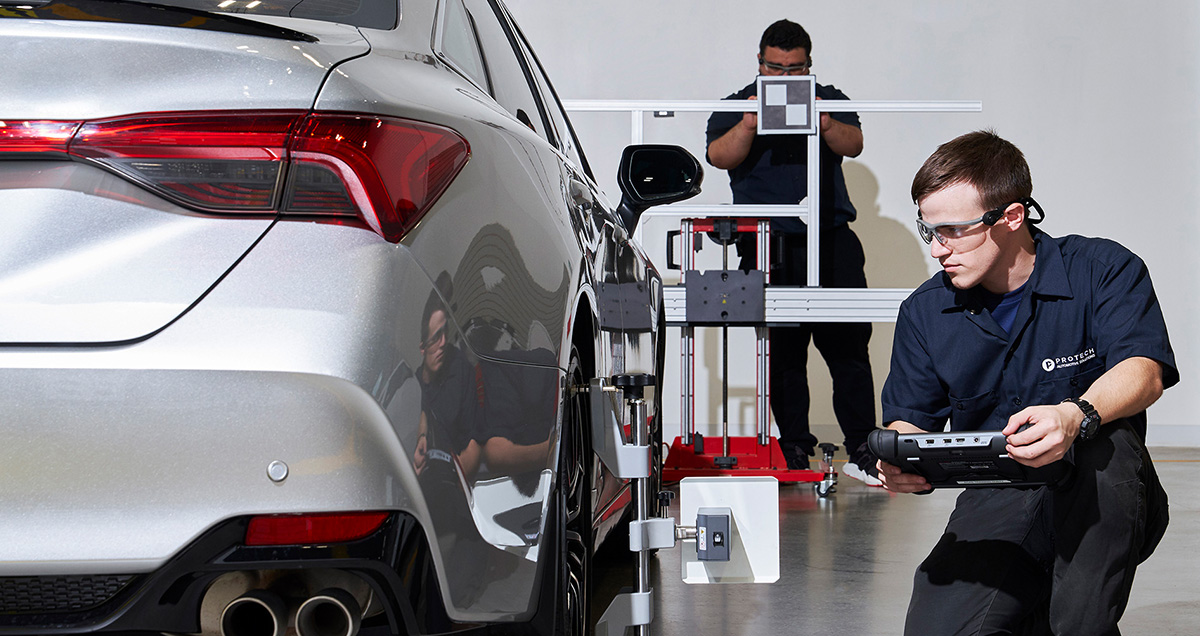


The True Cost of ADAS Equipment: The Complete Investment in Customer Safety
Safety systems require precise tools, and precision requires ongoing investment. When collision shop owners research ADAS equipment, they typically find base systems starting around $75,000-$150,000. But here's what the complete picture reveals: that initial purchase represents just the beginning of total investment required to maintain proper calibration capability across all major OEMs. 1
ADAS alignment equipment requires continuous investment in software subscriptions, updates, replacements, and manufacturer-specific tools to ensure safe, accurate calibrations that meet OEM specifications.
🐘 And sure, let’s acknowledge the elephant in the room. We are Protech Automotive Solutions. This is what we do, and we want you to work with us. We’ve invested millions of dollars to cover the country with OEM-specific targets and tools, so you don’t have to. That said, we also want you to make a well-informed decision.
Let's examine what collision centers are really committing to when they equip facilities for ADAS calibrations, and what it means for both safety performance and financial planning.
What’s Included in Your Initial ADAS Equipment Investment, and What’s Missing
Common Components in a Base ADAS Setup
The visible equipment cost—often $75,000 to $150,000—is just the beginning. Beneath the surface are ongoing requirements that drive total cost far higher. 1
A basic ADAS setup typically includes:
- Alignment/calibration frame system
- Computer hardware and base diagnostic software
- Initial target set (providing partial vehicle coverage)
- Entry-level scan tool capability
- Limited manufacturer platform coverage
OEM-Specific Tools You’ll Need for Full Coverage
OEM-specific tools for comprehensive coverage, specialized fixtures for particular vehicle configurations, premium software modules for advanced systems, and the extensive target inventory needed for complete OEM support.
The Hidden Costs Collision Shops Often Overlook
Providers that offer remote support are frequently called on for the trickier jobs when your car side needs support the most. It is like having your dentist on speakerphone, talking to the hygienist through a root canal.
These call centers can also make you wait for an hour or more after you have moved a car into a bay and plugged in the scan tool. You just don't know when you will receive that support so you are tying up that space and that technician for an indeterminate but unprofitable amount of time.
Storage and Environmental Requirements
Proper storage for targets and fixtures requires climate-controlled space—environmental exposure damages precision calibration instruments and affects accuracy over time.
Software Subscriptions: The Ongoing Expense You Cannot Ignore
Annual OEM Subscription Costs Explained
Hardware represents capital expenditure. Software subscriptions represent operational costs that continue indefinitely:
- OEM Software Subscriptions: Over $4,000+ annually for some brands 1
- Constant Updates: New model years bring new calibration protocols
- Multiple Platform Requirements: Complete coverage requires subscriptions across all major manufacturers
- No Prorating: Coverage gaps mean inability to calibrate affected vehicles
Total annual software costs can represent substantial ongoing operational expenses beyond initial equipment purchase.
How Missed Renewals Impact Your Calibration Capability
Miss a renewal? Equipment functionality is affected for those vehicle lines. Need additional coverage? Full subscription cost applies. These subscriptions typically increase annually, compounding long-term operational costs.
How Technology Evolution Impacts Your ROI
The 5-Year Lifecycle of ADAS Equipment
ADAS technology evolves as manufacturers introduce new safety systems and update existing platforms:
Technology Evolution Pattern:
- Years 1-2: Systems handle current model coverage effectively
- Year 3: New sensors and systems require additional tool investments
- Year 4: Major updates needed to maintain comprehensive coverage
- Year 5: Significant upgrade or replacement considerations emerge
Why Obsolescence Happens Faster Than You Think
Real Industry Example: When manufacturers introduced new camera-based systems with different specifications, collision centers with equipment optimized for previous technology faced immediate capability gaps.
Beyond equipment purchase and software subscriptions: 1
- Tool & Fixture Storage: Hundreds of OEM-specific targets and fixtures requiring organized storage
- Equipment Calibration: Annual calibration of calibration equipment to maintain accuracy
- Replacement Components: Damaged targets requiring replacement to maintain precision
- Software Support: Technical support contracts for diagnostic platforms
- IT Infrastructure: System maintenance and updates for calibration computers
- Obsolescence: Rapid technology turnover shortens useful equipment life
These operational requirements add to the total cost of maintaining ADAS capability over time.
Is Equipment Ownership Right for Your Collision Center?
Rather than focusing only on initial purchase price, consider the complete investment picture:
Timeframe Considerations:
- Year 1: Equipment + facility modifications + initial tooling
- Years 1-3: Add ongoing subscriptions + procedure updates + tool additions
- Years 1-5: Include equipment replacements + obsolescence management + capability expansion
Volume Requirements for Financial Viability
To justify equipment ownership investment, collision centers typically need:
- Consistent weekly calibration volume supporting fixed costs
- Year-round demand stability maintaining equipment utilization
- Diverse vehicle coverage capability matching market mix
- Operational capacity to absorb ongoing subscription and update costs
Industry Reality: For some centers, in-house calibration can make sense, particularly when they have unused space with no opportunity cost, high calibration volume (50+ per week), existing ADAS-trained staff, OEM certification or can meet OEM program requirements, multi-location scale to spread fixed costs, and limited access to mobile specialists 1
For most operators, however, realistic volume projections make ROI challenging when complete costs are considered.
Key Questions Before You Commit to Ownership
- Can operational volume support ongoing costs that include substantial annual subscriptions?
- Are you prepared for equipment to require updates and additions as technology evolves?
- Do you have cash flow capacity for necessary updates and replacements?
- Will your market support the calibration volume needed for financial viability?
- Have you calculated the complete 5-year cost of ownership versus alternatives?
The Specialist Partnership Alternative: A Smarter Way Forward
How National Providers Absorb the Risk for You:
National ADAS providers have collectively invested millions in equipment, training, and certifications across all major OEMs. These investments allow repair centers to access advanced calibration capabilities without replicating the same infrastructure. 1
- All equipment purchases, updates, and technology evolution
- Every software subscription across all major OEM platforms
- Obsolescence risk and replacement investment requirements
- Maintenance, calibration, and accuracy verification
Result: Access to comprehensive equipment capability for predictable operational cost—typically a fraction of what complete ownership and maintenance would require.
Why Outsourcing Can Improve Profitability and Safety
That initial equipment purchase is like the tip of an iceberg—most of the total investment extends well beyond what is immediately visible. Leading calibration providers manage this complexity across dozens of OEM platforms, maintaining certifications, training, tool updates, and compliance documentation. These are continuous investments required to keep calibration accuracy aligned with evolving vehicle technology. 1
For most collision centers, the financial analysis favors partnership over ownership. Specialist providers handle the equipment investment while collision centers focus on maximizing profitable collision repair operations.
Incorrect calibrations have real-world consequences. For example, even a 1.5-degree floor slope can cause a camera or radar sensor to misalign, leading to system malfunctions or inaccurate alerts. Proper calibration to OEM specifications ensures that every vehicle performs as designed. 1
The Real Cost of ADAS Equipment - The Bottom Line
ADAS equipment ownership means committing to ongoing costs extending well beyond initial purchase price. Before making equipment investment decisions, calculate the complete cost of ownership over a realistic operational timeframe, not just the initial sticker price.
Leading collision centers are discovering that accessing equipment through specialist partnership delivers superior financial returns compared to ownership. Rather than investing in depreciating assets with ongoing operational costs, they access complete capability for a fraction of total ownership investment.
Ready to Access Complete ADAS Equipment Without the Investment Burden?
Protech Automotive Solutions maintains comprehensive investment in ADAS calibration equipment across all major OEM platforms. Partner with us to access every tool and target needed—without the financial commitment of ownership.
Learn more: 1-800-PROTECH | protechautomotivesolutions.com
References
1 Protech Automotive Solutions. (2025). Internal operational benchmarking and cost analysis.
Additional Industry Resources:
I-CAR OEM Calibration Requirements
I-CAR ADAS Resources